

2026 - Quarter 2 Challenge - CGM - Continuous Glucose Monitor
This quarter, we’re diving deep into understanding how our bodies respond to everyday life by using a Continuous Glucose Monitor (CGM). This isn't just for diabetics—it's a powerful tool to see how your specific body reacts to things like:
Food: How does a bowl of pasta compare to a steak, or white bread versus white bread with peanut butter?
Lifestyle: How do exercise, sleep, and even stress levels impact your real-time blood sugar?
Managing your glucose is one of the most effective ways to boost longevity and avoid that dreaded 2:00 PM energy crash.
How to Join the Challenge:
Decide to Participate: Whether you’re ready to dive in or just want to follow along and learn, everyone is welcome!
Get Your CGM: We’re using the Lingo brand (over-the-counter). You can find it on Amazon for about $43.
Pro-Tip: Use the code LNGHCP2 in the promotion section on Amazon to save an extra 10%!
Timing: Aim to have your monitor by May 3rd so we can all start together.
Each monitor lasts for 14 days, and I’ll be sharing my own insights and recordings along the way. If you’re still on the fence, feel free to watch the recordings later and join in when you’re ready!
Ready, Set, Go: Setting Up Your CGM for Success
The first step toward mastering your metabolic health is getting your continuous glucose monitor (CGM) up and running. In these videos, Dr. Jamie Baines walks you through the practical, "real-world" experience of setting up your Lingo sensor, from unboxing to syncing.
What You’ll Learn:
The Prep Work: Why a simple alcohol wipe is your best friend before application (and a quick tip on what to do if you forget!).
App First, Sensor Second: The critical "order of operations"—downloading the Lingo app before you apply the sensor to access their step-by-step installation guides.
The "Syncing" Window: A quick heads-up on the 60-minute wait time it takes for your new sensor to calibrate and begin providing real-time data.
Real-Time Experiments: How to use your first few hours to observe baseline reactions to your favorite snacks (like peanut butter, Nutella, and pretzels!).
Why It Matters
By connecting your sensor properly, you are opening a 24/7 window into how your body responds to food, movement, sleep, and stress. This baseline data is the foundation of our entire Q2 Challenge, allowing us to move from guessing to knowing.
Pro Tip: Don't stress the "perfect" application. The Lingo app is incredibly intuitive and will guide you through the process in real-time. Once you're synced, the real discovery begins!
Lesson 1
Understanding Your CGM Data: Your First Look at Real-Time Glucose
Now that your Continuous Glucose Monitor (CGM) is on, it’s time to learn how to read your data and understand what your body is telling you. In this lesson, Dr. Jamie Baines walks through the app, key terms, and what your numbers mean.
What You’ll Learn:
Reading Your Numbers: How to understand your current glucose, graphs, and daily trends
Tracking Events: How to log meals, sleep, stress, and activity to connect with glucose changes
Normal Ranges: What healthy levels look like (70–140, fasting around 70–100)
After Eating: How glucose rises within 1 hour, then returns to baseline within 2–3 hours
Food Impact: How the glycemic index affects how quickly foods spike your blood sugar
Why It Matters
Your CGM gives you a real-time view of how your body responds to everyday habits. By learning your baseline and patterns, you can start making simple changes that improve energy and long-term health.
Pro Tip: Spend the first few days just observing—track your patterns, learn your baseline, and get curious before making any changes.
Lesson 2
Real-Time Experiment: How Exercise Impacts Your Glucose
In this quick example, Dr. Jamie Baines shares how her glucose responded in real time after eating and exercising—showing just how dynamic your body can be.
What You’ll Learn:
Food Spikes: How sugary foods (like candy) can cause rapid glucose increases
Exercise Impact: How movement (like a Peloton ride) can help bring glucose levels down
Timing Matters: How quickly your glucose can rise and fall within a short window
Body Response: How your body may continue lowering glucose even after exercise stops
Why It Matters
This is a real-life example of how food and movement directly affect your glucose. Your body is constantly adjusting, and small actions—like exercise—can make a big difference.
Pro Tip: Try light movement after eating (like walking or a short workout) and watch how your glucose responds in real time.
Lesson 2.1
Q2 Challenge Lesson 2.1: The Candy Spike & The Exercise "Backdoor"
In Lesson 2, we’re moving from observation to action. We’ve seen our baselines—now, let’s talk about what actually happens in our bodies when we eat high-glycemic foods and how we can use movement to "hack" the system.
The "Sour Patch Kids" Experiment
Dr. Jamie Baines shares a real-time look at her CGM data following a classic "high-sugar hit." Watch as she navigates the sharp spike after eating candy and then tests the power of her Peloton to bring those numbers back down.
Key Takeaways from the Peloton Ride:
The Surge: See how quickly blood sugar rises when "rocket fuel" (candy) hits the system.
The VIP Backdoor: Understand how muscles acting as "glucose sponges" can pull sugar out of the blood even more efficiently than insulin alone.
The Overshoot: Dr. Baines discusses Reactive Hypoglycemia—when the body releases too much insulin in a panic, causing a sharp crash below baseline.
The Science of Glucose Velocity
To help you master these concepts, check out the AI explainer below. It breaks down:
The Glycemic Index: Why some carbs act like a lightning bolt while others are a "slow burn."
Insulin Mechanics: How your pancreas acts as a sensor to unlock your cells.
The 10-Minute Rule: Why short bursts of activity right after a meal are the "gold standard" for metabolic health.
Your Homework:
Identify a "Rocket Fuel" Food: Find one high-glycemic food you enjoy and track your response.
Test the "Backdoor": Try 10–15 minutes of light movement (brisk walk or air squats) immediately after a carb-heavy meal. Compare that graph to a day you stayed sedentary after eating!
Metabolic Tip: If you see a deep "valley" on your graph (a fast drop after a spike), don't panic. It’s a signal that your body over-corrected. Your goal for the next meal isn't to fix the low—it's to prevent the high that caused it by "clothing your carbs" with fiber and protein.
Watch both videos below to master the mechanics of your metabolism!
Lesson 3
Real-Time Experiment: How Exercise Impacts Your Body’s Fuel System
In this real-life example, Dr. Jamie James shares how her body responded in real time during a busy Mother’s Day—showing how quickly glucose levels can change with movement, exercise, and fueling.
What You’ll Learn:
Morning Baseline: How glucose can start in a stable range even after waking up
Exercise Effect: How a bike ride can cause the body to use and even produce fuel while fasting
Glucose Production: How the liver can create glucose (gluconeogenesis) during activity
Fuel Depletion: How continued movement without food can eventually lead to “running out” of energy
Recovery Need: Why refueling after activity is essential to restore energy levels
Why It Matters
This example shows how dynamic the human body is—constantly adjusting energy levels even when no food is being consumed. Exercise, timing, and fueling all work together to keep your body functioning efficiently.
Pro Tip: After exercise, refuel your body with a balanced snack or meal to help restore energy and support recovery.
Q2 Challenge Lesson 3.1:
How your body manufactures sugar when you need it, even if you haven't eaten.
Now that you’ve seen your baseline data, it’s time to move from observation to action.
The Science of the "Fasted Rise"
You might notice your glucose levels rising during a workout even if you haven't eaten. This is your body in high-performance mode! Through a process called gluconeogenesis, your liver manufactures and releases its own sugar to fuel your muscles. While this causes a "spike" on your graph, it is a healthy, productive response to exercise. However, remember that your body has limits; after about 60-90 minutes of high-intensity effort, those internal stores can run low, leading to the "bonk" or a sudden crash if you don't refuel.
Lesson 4 New Video: The Biology of the "Gus" Glitch
Why Your Cravings Aren’t a Character Flaw—They’re a Biological Hack
Ever feel like you just can't stop at one cracker, or wonder why that 2:00 PM energy crash hits so hard? Meet Fat Gus, the local squirrel who inadvertently became our metabolic masterclass.
In this beautifully animated short, we dive into the Carb Addiction Cycle through the eyes of our favorite furry neighbor. Watch as we explore:
The "Bliss Point": How processed foods are engineered to bypass your brain's "stop" signals.
The Insulin Lock: The science behind why fat burning shuts down when glucose spikes.
Flattening the Curve: Three actionable, "Gus-proof" strategies to reclaim your energy and break the cycle of cravings for good.
The Power of CGM: A CGM makes these invisible chemical reactions visible, turning your metabolism from a mystery into a manageable dashboard. Watch the video above to see how you can stop fighting your biology and start mastering it!
The Tale of Fat Gus
LESSON 4.1: Metabolic Sabotage: Why Even Squirrels Can’t Resist the Spike
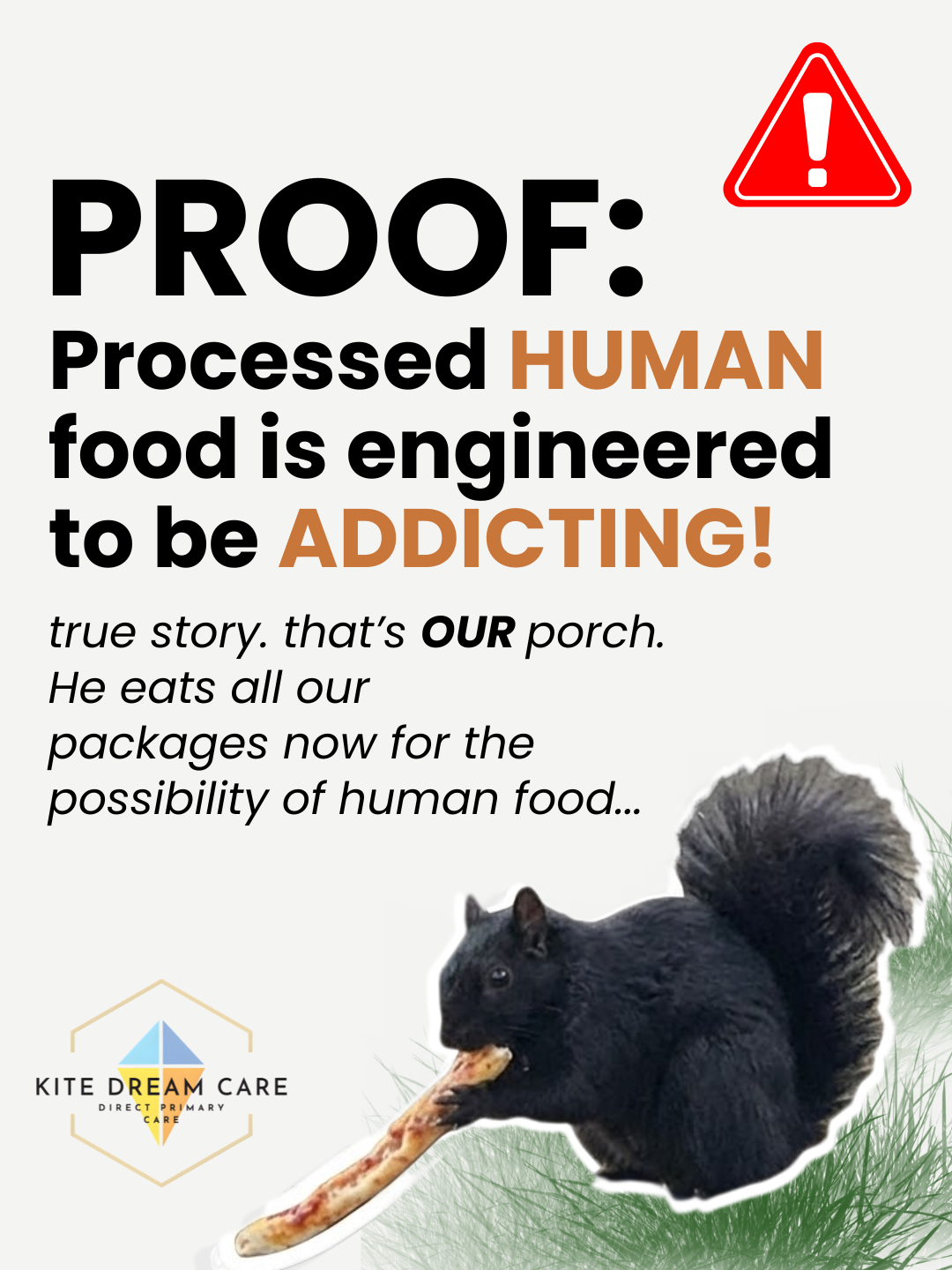
Meet "Fat Gus," our local squirrel and the unofficial mascot of Lesson 4. Gus recently discovered the world of processed human carbs, and his behavior changed overnight. He no longer hunts for acorns; he hunts for packages.
Gus is a living demonstration of the Carb Addiction Cycle. Once his brain associated human packages with high-glucose rewards, his "stop" signal vanished. In this lesson, we look at the science of why processed carbs are engineered to be hyper-palatable and how they create "cravings" that override even the strongest survival instincts—whether you have a tail or not!
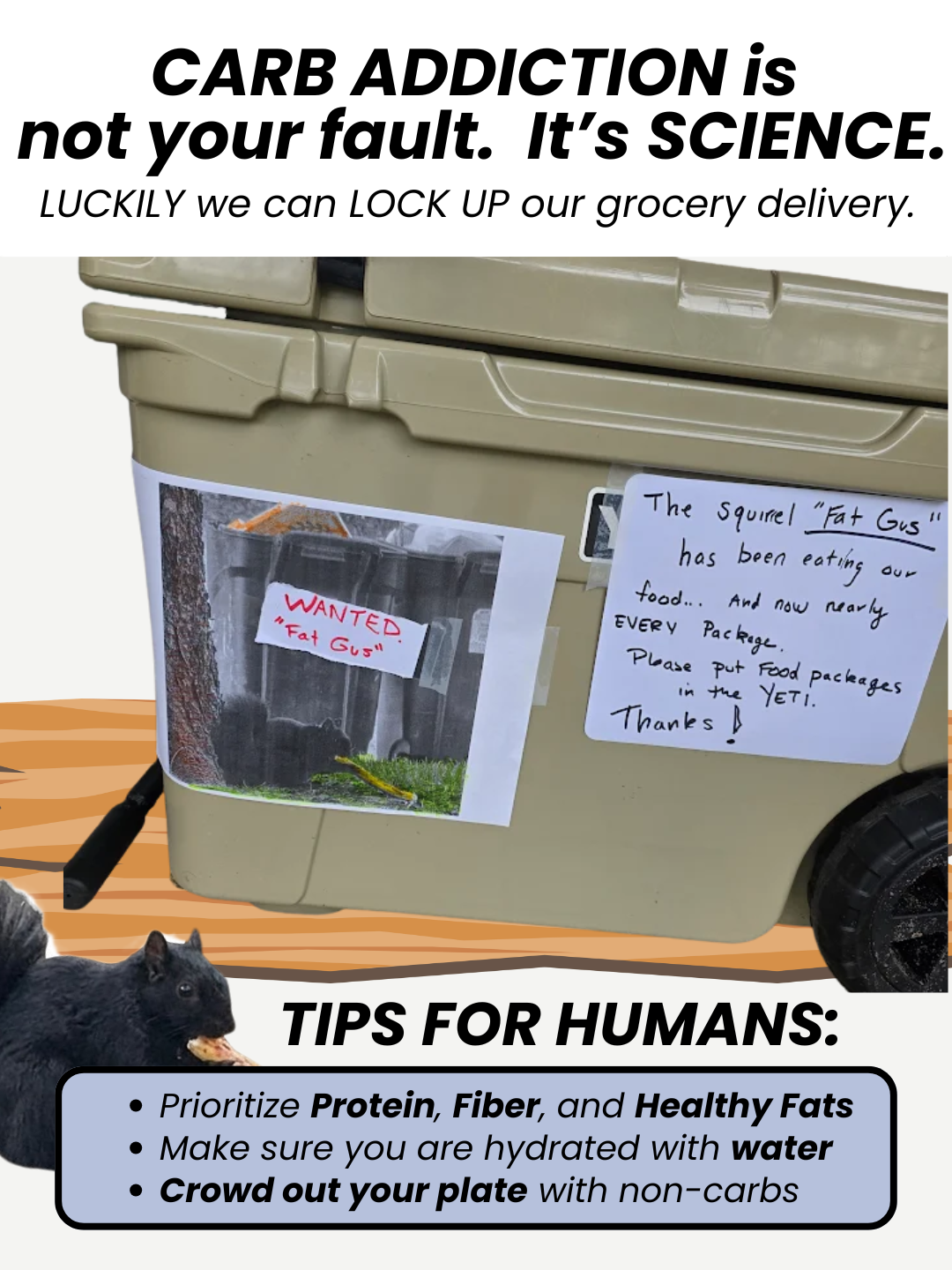
Lesson 4.2: The Carb Addiction Cycle and Metabolic Health
In this lesson, Dr. Jamie Baines explains how processed foods affect metabolism, cravings, blood sugar, and energy levels using the story of “Gus” the squirrel as an example of how modern food can disrupt natural biological systems.
What You’ll Learn:
How natural metabolism is designed for steady energy from whole foods
How processed foods high in sugar, salt, and fat trigger strong dopamine responses in the brain
How leptin, the hormone responsible for fullness signals, can become overridden by highly processed foods
How high-glycemic foods create rapid blood sugar spikes followed by crashes
What reactive hypoglycemia is and how it contributes to cravings, fatigue, irritability, and brain fog
The “spike, crash, crave” cycle associated with carbohydrate cravings
How pairing carbohydrates with protein and fiber can slow glucose absorption and reduce sharp spikes
How light movement after meals helps muscles absorb glucose more efficiently
How continuous glucose monitors (CGMs) can help visualize blood sugar patterns and metabolic responses in real time
Why It Matters
Understanding how processed foods affect blood sugar, hormones, and cravings can help people make informed decisions that support more stable energy levels and healthier metabolic function.
Pro Tip
Pair carbs with protein and fiber, and include light movement after meals to help support steadier blood sugar and reduce energy crashes.
Lessone 4.3: Here is a punchy, condensed version for your website:
The Inspiration: Mark Rober’s "Walnut Heist"
Watch the original heist that inspired it all: Before he was our metabolic mascot, "Fat Gus" was the mastermind of the world’s most famous backyard obstacle course. We were inspired by Mark Rober’s legendary squirrel heist, which showcases the incredible intelligence and athletic mastery of these animals.
Why we love this:
Mental Athletes: Squirrels are expert problem-solvers who can "hack" complex engineering and memorize blueprints.
Physics Masters: From conservation of angular momentum to terminal velocity, they are built-in physics engines.
The Contrast: Seeing how brilliant these creatures are makes it even more shocking how easily a "processed carb spike" can hijack their hard-wired survival instincts.
Lesson 5: How CGMs Can Support Weight Loss and Healthy Habits
In this lesson, Dr. Alissa Citron explains how continuous glucose monitors (CGMs) can help people better understand how food, exercise, and sleep affect blood sugar levels—and how that awareness can support healthier lifestyle choices.
What You’ll Learn:
Real-Time Feedback: How CGMs show immediate changes in blood sugar after eating, exercising, or sleeping
Behavior Awareness: How seeing glucose patterns can motivate healthier food and activity choices
Personalized Responses: How each person’s body reacts differently to certain foods and habits
Exercise Impact: How simple activities like walking after meals can help lower glucose spikes
Weight Loss Support: Why CGMs work best when combined with exercise, nutrition guidance, and healthy lifestyle changes
Short-Term Tracking: Why using a CGM for a few weeks can help identify patterns and encourage lasting habits
Mindset Reminder: Why CGMs should be used as a learning tool—not as a measure of success or failure
Why It Matters
CGMs make it easier to understand how everyday habits affect the body in real time. This awareness can help people make more informed decisions about food, movement, and overall wellness while building healthier long-term habits.
Pro Tip: Focus on patterns, not perfection. Small lifestyle changes—like balanced meals and movement after eating—can make a meaningful difference over time.
Lesson 6
Fun Reactions From Our Participants
In this lesson, one participant shares a humorous real-time reaction after their CGM stopped displaying a glucose reading because the level dropped below the monitor’s readable range.
What You’ll Learn:
How CGMs may stop displaying readings when glucose levels fall below 55
Why missing readings can happen during glucose monitoring
How participants observe and react to glucose changes in real time
How beverages like coffee may affect glucose readings and energy levels
Why It Matters
Real-time CGM experiences help participants better understand how their bodies respond to daily habits, fasting, food, and beverages.
Pro Tip
Use CGM readings as a tool for awareness and learning by observing patterns and trends over time.